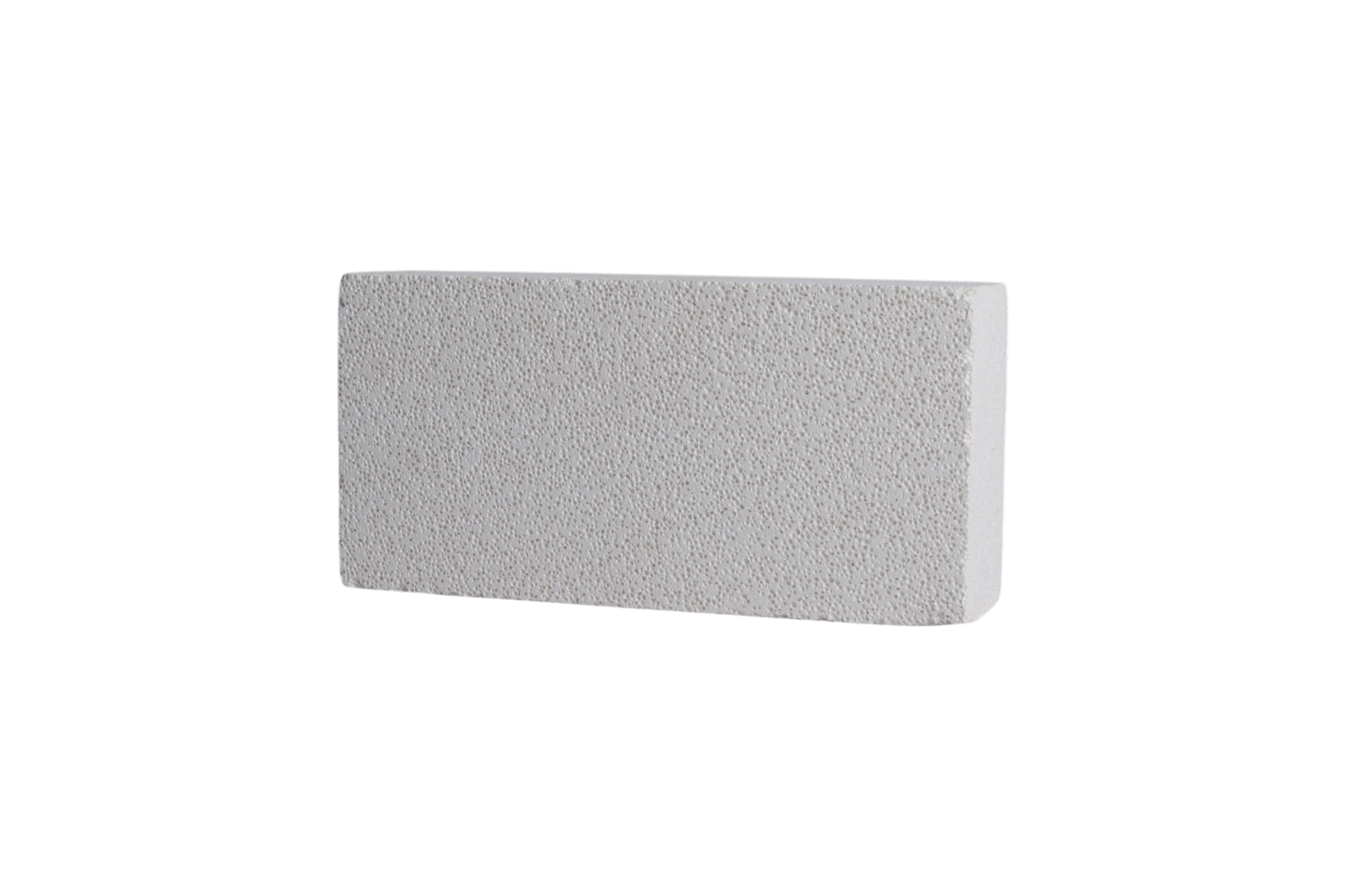
Insulating Firebrick
(IFB) — Lightweight
Insulating Firebrick (IFB) is a lightweight, high-porosity refractory brick produced by introducing combustible additives into the alumino-silicate body before firing, creating a controlled cellular microstructure that dramatically reduces thermal conductivity and bulk density versus dense refractory brick. With Al₂O₃ content from 30% to 65% and bulk density from 0.5 to 1.3 g/cm³, IFB provides both structural form and thermal insulation in a single element — eliminating the need for separate insulating layers in intermediate and backup lining positions. Service temperature up to 1400°C. Five grades covering the full range of industrial furnace and kiln temperature zones.
IFB Grade Matrix — Five Grades, Full Parameters
Insulating Firebrick — IFB Series
All five grades are produced under the same ISO 9001 quality system. The VRF-IFB26 and VRF-IFB28 grades cover the majority of intermediate lining and backup applications in cement kilns and industrial furnaces. Higher-alumina grades (IFB32/IFB36) are specified for hot-face insulating lining positions in high-temperature furnaces. All grades comply with ASTM C155 classification. Standard size: 230×114×65mm (equivalent to ISO metric brick).
| Grade | ASTM Class | Al₂O₃ (%) | B.D. (g/cm³) | CCS (MPa) | Max Svc Temp (°C) | λ at 400°C W/(m·K) | PLC (%) |
|---|---|---|---|---|---|---|---|
| VRF-IFB23 | K-23 | ≥ 30 | 0.50–0.65 | ≥ 1.5 | 1260 | ≤ 0.28 | ±1.5 |
| VRF-IFB26 | K-26 | ≥ 40 | 0.65–0.85 | ≥ 2.5 | 1320 | ≤ 0.32 | ±1.5 |
| VRF-IFB28 ★ Recommended | K-28 | ≥ 50 | 0.85–1.05 | ≥ 4.0 | 1370 | ≤ 0.36 | ±1.0 |
| VRF-IFB30 | K-30 | ≥ 55 | 1.00–1.20 | ≥ 5.5 | 1400 | ≤ 0.40 | ±1.0 |
| VRF-IFB36 | K-36 | ≥ 65 | 1.15–1.30 | ≥ 7.0 | 1400 | ≤ 0.44 | ±1.0 |
B.D. = Bulk Density · CCS = Cold Crushing Strength · λ = Thermal Conductivity · PLC = Permanent Linear Change after 5h at max service temp · ASTM K-class = max continuous use temperature in hundreds of degrees Fahrenheit · ★ Highlighted grade is recommended for general intermediate lining applications
IFB vs Dense High-Alumina Brick — When to Use Each
The choice between IFB and dense high-alumina brick (HAB) depends on the lining function. IFB is used as an insulating element — reducing heat loss, shell temperature, and fuel consumption. Dense HAB is used as a working face — resisting abrasion, mechanical loading, and chemical attack from process gases or slag. In most multi-layer lining designs, both are used together: HAB working face, IFB intermediate layer, and CFB blanket backup.
| Property | IFB | Dense HAB | Design Use |
|---|---|---|---|
| Bulk Density | 0.5–1.3 g/cm³ | 2.2–3.1 g/cm³ | IFB = insulating layer |
| Thermal Conductivity | Low | High | IFB reduces heat loss |
| CCS | 1.5–7 MPa | 50–100 MPa | HAB for load-bearing |
| Alkali Resistance | Moderate | High | HAB for process exposure |
| Abrasion Resistance | Low | High | HAB for working face |
| Cost per m² lining | Lower | Higher | IFB for backup positions |
IFB by Application Zone
Kiln & Furnace Intermediate Layer
Between the working face brick/castable and the outer insulation, IFB28 reduces the temperature reaching the CFB backup layer and steel shell — improving overall thermal efficiency. The rigid brick form allows stacking under compressive load without the compression management required for fibre backup.
Thermal Backup Behind Dense Brick
In multi-layer kiln designs, IFB26 or IFB28 placed behind dense high-alumina working brick reduces shell-face temperature by 100–150°C compared to single-layer brick construction. The combination extends shell life and reduces heat loss without increasing the total lining thickness.
Heat Treatment Furnace Lining
Car-bottom, bell, and batch furnaces for heat treatment and annealing. IFB28 and IFB30 provide the structural integrity for self-supporting arch construction combined with the low thermal mass required for rapid cycling furnaces — reducing energy consumption per heat cycle.
Tunnel Kiln Car Top Deck
IFB provides the combination of high service temperature, low thermal mass, and dimensional stability required for tunnel kiln car deck construction. The standard brick format allows straightforward replacement during maintenance without specialised forming equipment.
High-Temp Hot-Face Lining
In applications where the process gas is clean (no slag, dust, or alkali attack) and temperatures reach 1350–1400°C, IFB36 can be used as a hot-face lining element — combining insulation and containment in a single brick layer. Significantly reduces system weight versus a two-layer dense + insulating design.
Special Shapes & Formats
In addition to the standard ISO metric brick (230×114×65mm), IFB can be supplied in arch, wedge, key, and skew shapes for arch and crown construction, as well as custom dimensions for project-specific applications. Specify application geometry and required ASTM K-class when enquiring.
Insulating Firebrick FAQ
The ASTM K-class (per ASTM C155) indicates the maximum continuous service temperature in hundreds of degrees Fahrenheit — K-26 = 2600°F (approximately 1427°C). The Vuulcan IFB product names use the K-class reference for cross-compatibility with international specifications. When specifying IFB for a project, match the K-class to the maximum expected hot-face temperature of the IFB layer (not the process temperature, which is typically absorbed by the working face lining in front of the IFB).
Dense high-alumina brick (HAB) has thermal conductivity of 2–4 W/(m·K) at 400°C. IFB thermal conductivity is 0.28–0.44 W/(m·K) at the same temperature — approximately 5–10× lower. In practical terms, a 114mm course of IFB28 provides the same insulating value as approximately 600–800mm of dense HAB. This allows multi-layer lining systems to achieve lower shell temperatures and higher thermal efficiency without excessive total lining thickness.
IFB can serve as a working face in clean environments (no alkali, dust, or slag attack) at temperatures within the grade's service limit. However, the cellular microstructure that gives IFB its low thermal conductivity also means lower mechanical strength and lower resistance to chemical attack compared to dense brick. For cement kilns (high alkali environment), steel furnaces (slag exposure), or any abrasion-intensive application, IFB should not be used as the working face — specify dense HAB or LCC castable for the working face, with IFB as the backup layer.
Minimum order quantity is 5 tonnes per grade. Standard brick (230×114×65mm) is palletised on wooden export pallets with edge protection. A 20-foot general-purpose container loads approximately 18–20 tonnes. Special shapes are packed in custom wooden crates to prevent breakage. Lead time from order confirmation to FOB Qingdao is typically 3–4 weeks for standard grades, 5–6 weeks for special shapes. For small evaluation orders, contact us with your application and we will advise on minimum quantities.
Every shipment includes a batch Certificate of Analysis (COA) with actual tested values for bulk density, cold crushing strength, and permanent linear change. The Technical Data Sheet (TDS), MSDS, and installation guidance are supplied as standard. For orders ≥ 5 tonnes, third-party inspection (SGS, Bureau Veritas, Intertek) can be arranged at the production facility before shipment.
Get a Proposal for Insulating Firebrick
Specify your ASTM K-class, application, and quantity. Our technical team responds within 1 business day with pricing, lead time, and a batch COA for the relevant grade.