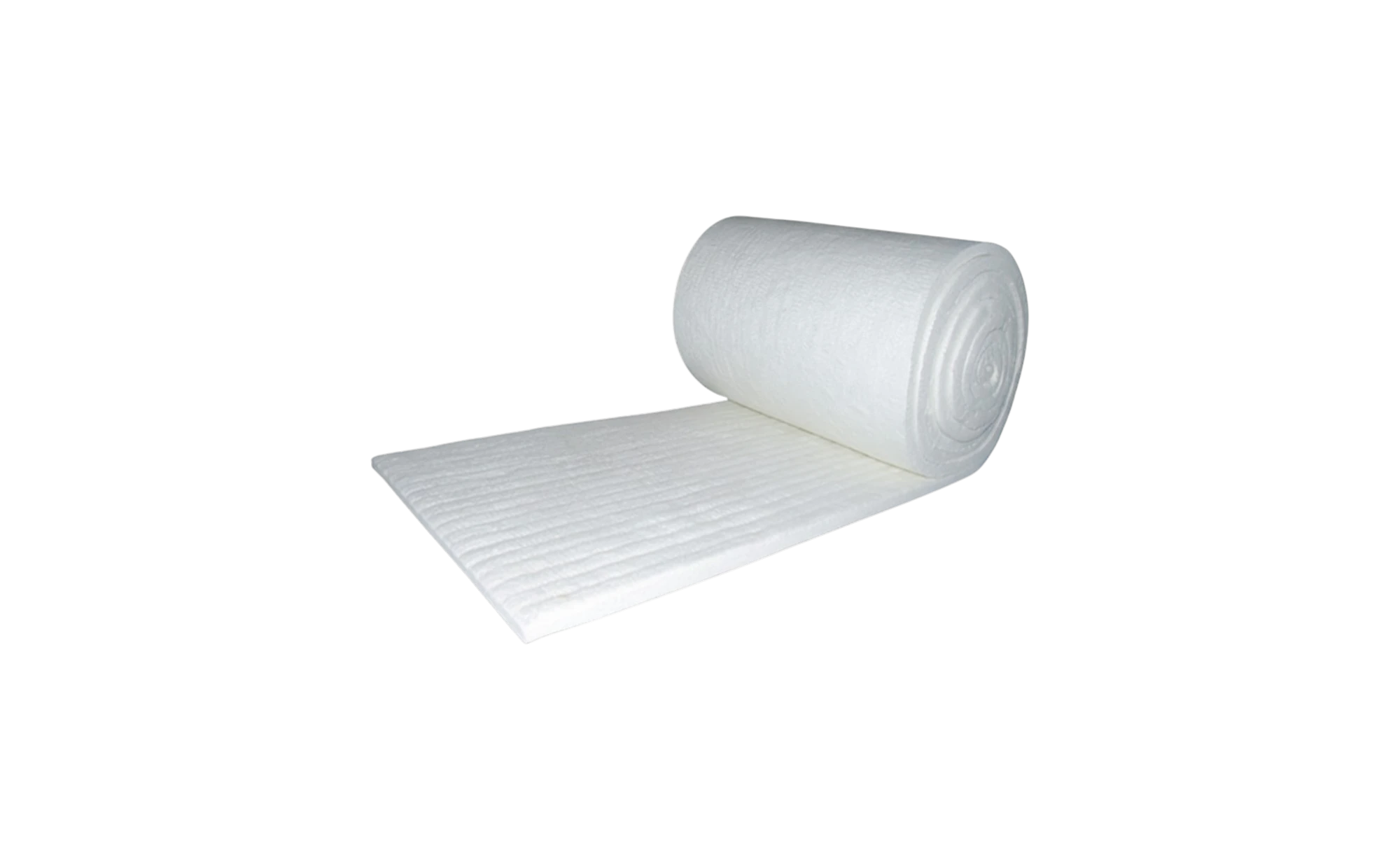
Ceramic Fiber Blanket
(CFB) — High Temperature
Ceramic Fiber Blanket (CFB) is a high-temperature refractory insulation material produced by melting alumino-silicate raw materials and converting the melt into fibres through spun or blown processes. The resulting blanket structure provides exceptional thermal insulation at temperatures from 1000°C to 1430°C, with low heat storage, low thermal conductivity, and excellent thermal shock resistance. Available in three temperature classifications (1260°C, 1350°C, 1430°C) and density grades from 96 to 192 kg/m³. Primary applications include kiln backup insulation, furnace lining, expansion joints, and high-temperature pipe insulation.
CFB Grade Matrix — Temperature Class & Density
Ceramic Fiber Blanket — CFB Series
All grades share the same alumino-silicate composition and are available in both spun (lower shot content) and blown (more economical) process variants. The 1260C grade is the most widely used for backup insulation in cement and steel applications. Higher classification grades (1350C, 1430C) are specified where continuous operating temperatures exceed 1100°C. Standard blanket dimensions: 7200mm × 610mm rolls.
| Grade | Temp Class (°C) | Density (kg/m³) | Max Svc Temp (°C) | λ at 600°C W/(m·K) | Shot Content (%) |
|---|---|---|---|---|---|
| VRF-CFB96-1260 | 1260 | 96 | 1000 | ≤ 0.22 | ≤ 12 |
| VRF-CFB128-1260 | 1260 | 128 | 1050 | ≤ 0.20 | ≤ 10 |
| VRF-CFB128-1350 ★ Recommended | 1350 | 128 | 1150 | ≤ 0.19 | ≤ 10 |
| VRF-CFB160-1350 | 1350 | 160 | 1200 | ≤ 0.18 | ≤ 8 |
| VRF-CFB128-1430 | 1430 | 128 | 1200 | ≤ 0.19 | ≤ 10 |
| VRF-CFB192-1430 | 1430 | 192 | 1260 | ≤ 0.17 | ≤ 7 |
Temp Class = continuous use classification per ASTM C892 · λ = Thermal Conductivity · Shot Content = non-fibrous particles > 45μm · ★ Highlighted grade recommended for general kiln backup insulation
Spun vs Blown Process — Comparison
CFB is produced by two methods. The spun process uses centrifugal force to draw fibres from the melt, producing longer, more uniform fibres with lower shot content and better tensile strength — preferred for higher-duty applications and where low shot content is specified. The blown process uses high-velocity air to attenuate fibres, producing a softer, more economical blanket suitable for general backup insulation.
| Property | Spun Process | Blown Process | When to Specify |
|---|---|---|---|
| Fibre Length | Long, uniform | Short, random | Spun for integrity |
| Shot Content | ≤ 7–10% | ≤ 12–16% | Spun when < 10% required |
| Tensile Strength | Higher | Moderate | Spun for vibration zones |
| Cost | Higher | Lower | Blown for general backup |
| Typical Use | Furnace lining, joints | Backup insulation | — |
CFB by Application
Cement & Lime Kiln Backup Layer
Behind brick or castable working lining, CFB128-1350 reduces shell temperature and heat loss while allowing for differential thermal expansion. Lower shell temperature extends steel shell service life and reduces refractory anchor thermal stress.
Industrial Furnace Lining
For car-bottom, bogie-hearth, bell, and batch furnaces operating at 800–1200°C. CFB160-1350 or CFB192-1430 provides the combination of thermal insulation and structural integrity required for furnace roof and wall lining in heat treatment and forging applications.
High-Temperature Expansion Joints
CFB provides controlled compression at expansion joints between brick courses and at shell penetrations. The resilience of ceramic fibre allows repeated thermal cycling without loss of sealing performance — avoiding the cold-face gaps that form with rigid materials.
Hot Pipe & Equipment Insulation
Wrapping hot gas ducts, transfer lines, and vessels operating up to 1050°C. CFB96-1260 and CFB128-1260 provide lightweight, easy-to-install insulation that reduces heat loss and surface temperature to safe handling levels.
Folded Module Construction
CFB blankets are folded into modules for monolithic furnace lining systems, providing faster installation, lower labour cost, and easier maintenance access compared to castable or brick. The compressed module structure self-seals at joints under thermal expansion.
Steel Ladle & Tundish Insulation
Lightweight backup insulation behind ladle working lining. CFB significantly reduces ladle shell temperature, extending shell life and improving thermal efficiency of the heat. The low thermal mass reduces ladle warm-up time and energy consumption.
Ceramic Fiber Blanket FAQ
The temperature classification refers to the continuous use temperature limit per ASTM C892 — the highest temperature at which the blanket retains its physical properties over time without excessive shrinkage or degradation. 1260°C (standard) is suitable for backup positions where the hot face temperature does not continuously exceed ~1000°C. 1350°C (intermediate) is the most widely used grade for kiln and furnace backup insulation, handling hot-face temperatures to ~1150°C. 1430°C (high-duty) is specified for applications with sustained exposure above 1200°C, such as close-coupled backup behind low-mass furnace linings. Choose the classification based on the actual hot-face temperature of the CFB layer, not the process temperature.
Shot content refers to the percentage of non-fibrous glassy particles (> 45μm diameter) present in the blanket. Shot adds weight without contributing to insulation performance, and at high temperatures, shot particles can act as stress concentration points. Lower shot content (spun process, ≤ 7–10%) means more fibre per unit weight, better thermal insulation, and higher tensile strength. For most backup insulation applications, ≤ 12% shot content (blown process) is acceptable. Specify spun-process CFB when shot content < 10% is required — typical for higher-duty furnace linings.
CFB blanket is typically applied in layers with joints staggered. For backup insulation behind brick or castable, rolls are cut to length, placed against the shell, and held by stainless steel anchors or pins welded to the shell at 300–400mm centres. For layered construction, each layer is compressed by the next, ensuring no open joints. Joints between rolls should be offset by at least half a roll width to prevent hot-face exposure. No curing or drying is required — CFB can be heated directly after installation.
Minimum order quantity is 5 tonnes. Standard rolls are 7200mm × 610mm in 25mm or 50mm thickness, wrapped in polythene and palletised. A 20-foot container loads approximately 8–10 tonnes depending on density grade. For trial samples, we can arrange partial rolls — contact us with your application and we will advise. Lead time from order confirmation to FOB Qingdao is typically 3–4 weeks for standard grades.
In many backup and intermediate lining positions, yes. CFB offers three advantages over castable as a backup layer: lower thermal mass (faster heat-up and cool-down cycles), lower weight (reduces structural loading), and easier replacement during shutdowns. The trade-off is lower compressive strength — CFB is not suitable as a working face exposed to abrasion, mechanical loading, or chemical attack. The correct approach is to use CFB as a backup/insulating layer behind a castable or brick working face, combining the high-temperature performance of the working lining with the thermal efficiency of the fibre backup.
Get a Proposal for Ceramic Fiber Blanket
Specify your temperature classification, density, and application. Our technical team responds within 1 business day with pricing, lead time, and a batch COA for the relevant grade.